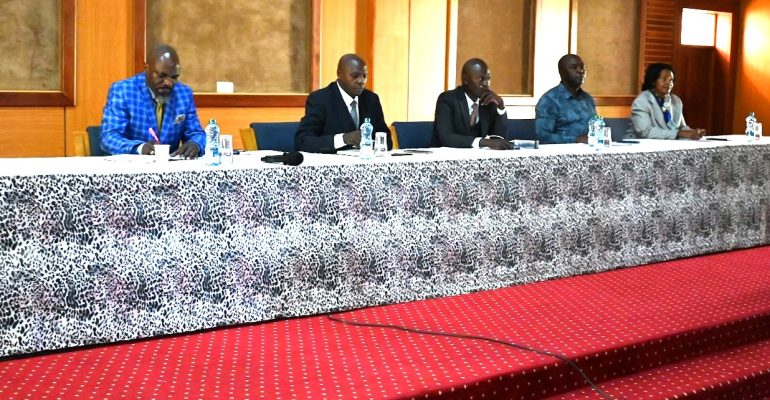
The Department of Research, Consultancy and Advisory Services, Strategic Leadership Development Programme Cohorts 540 and 541 convened the debate, bringing together a distinguished panel of speakers including Dr. (CPA) Lazarus Adhu, Dr. Jeremiah Mwendwa, Dr. Sila Kisingu, Ms. Margaret Karanja and Mr. Ezekiel Oriedo.
Titled “Interrogating the Dilemmas Between Kenya’s Development Policies and Continuity in the National Development Agenda in Changing Governments,” staff and course participants of the Kenya School of Government took part in a rich discourse examining the persistent challenges that undermine policy continuity and the realization of Kenya’s long-term national transformation agenda, despite the existence of extensive policy frameworks and institutional structures.
Deliberations were anchored on the observation that Kenya possesses a robust policy and strategic planning architecture that includes Kenya Vision 2030, medium-term plans, County Integrated Development Plans, sectoral master plans, Constitutional provisions on planning and public finance, and global commitments such as the SDGs. Despite this elaborate structure the country continues to face difficulties in sustaining national priorities across successive political administrations.
Speakers observed that Kenya’s development challenges stem from inconsistent implementation, fragmented execution, and weak coordination among institutions responsible for planning and oversight. Frequent political transitions often disrupt continuity through shifting priorities and rebranding of programmes, resulting in duplication, inefficient use of resources, weakened institutional memory, and stalled initiatives that ultimately affect service delivery and long-term national development outcomes.
To address these concerns, speakers proposed measures aimed at strengthening consistency, coordination, and accountability in national planning and implementation. Recommendations included establishment of a centralized technology-driven project management platform, stronger legal safeguards to protect ongoing programmes during political transitions, improved inter-agency collaboration, and creation of a national project continuity register to preserve institutional memory. Participants also emphasized the need for disciplined, data-driven economic planning supported by institutional stability and consistent execution.
The debate concluded with a shared consensus that the national transformation challenge lies not in the formulation of policies, but in consistency, collaboration, and effective execution across political cycles. Reinforcing legal safeguards, integrating digital monitoring platforms, and institutionalizing long-term planning mechanisms would ensure that national initiatives are treated as long-term public assets rather than short-term political undertakings.